From current-state complexity to connected Siemens Opcenter flow
The challenge: growth exposed hidden friction
A high-growth manufacturing organization was preparing for a line extension that would add new production areas, parallel workstreams, and more movement of materials, containers, lots, and subassemblies. The operation was already capable, but the future state would require stronger controls: fewer handoffs, clearer ownership, faster exception resolution, and better traceability across reagent preparation, flow-cell work, instrument assembly, quality checks, and release.
The team did not want to simply automate the current process inside Siemens Opcenter. They wanted to understand the actual value stream first, remove waste, and then configure Opcenter around a cleaner, more scalable workflow.
Before VSM
- Manual or informal decisions around material staging, container movement, and lot status.
- Multiple handoffs across manufacturing, quality, supply chain, and engineering.
- Potential duplication of containers, lots, or material transactions as new areas were added.
- System workflows that reflected functional silos more than end-to-end value flow.
Why Value Stream Mapping worked
VSM gave the team a practical way to see the whole operating system: process flow, information flow, system touchpoints, queues, rework loops, and decision delays. The workshop followed a proven pattern: define the value stream, map the current state, add kaizen bursts, prioritize improvements with an impact matrix, design the future state, and convert the work into a clear action plan.
1
8
4
90
The approach: map first, configure second
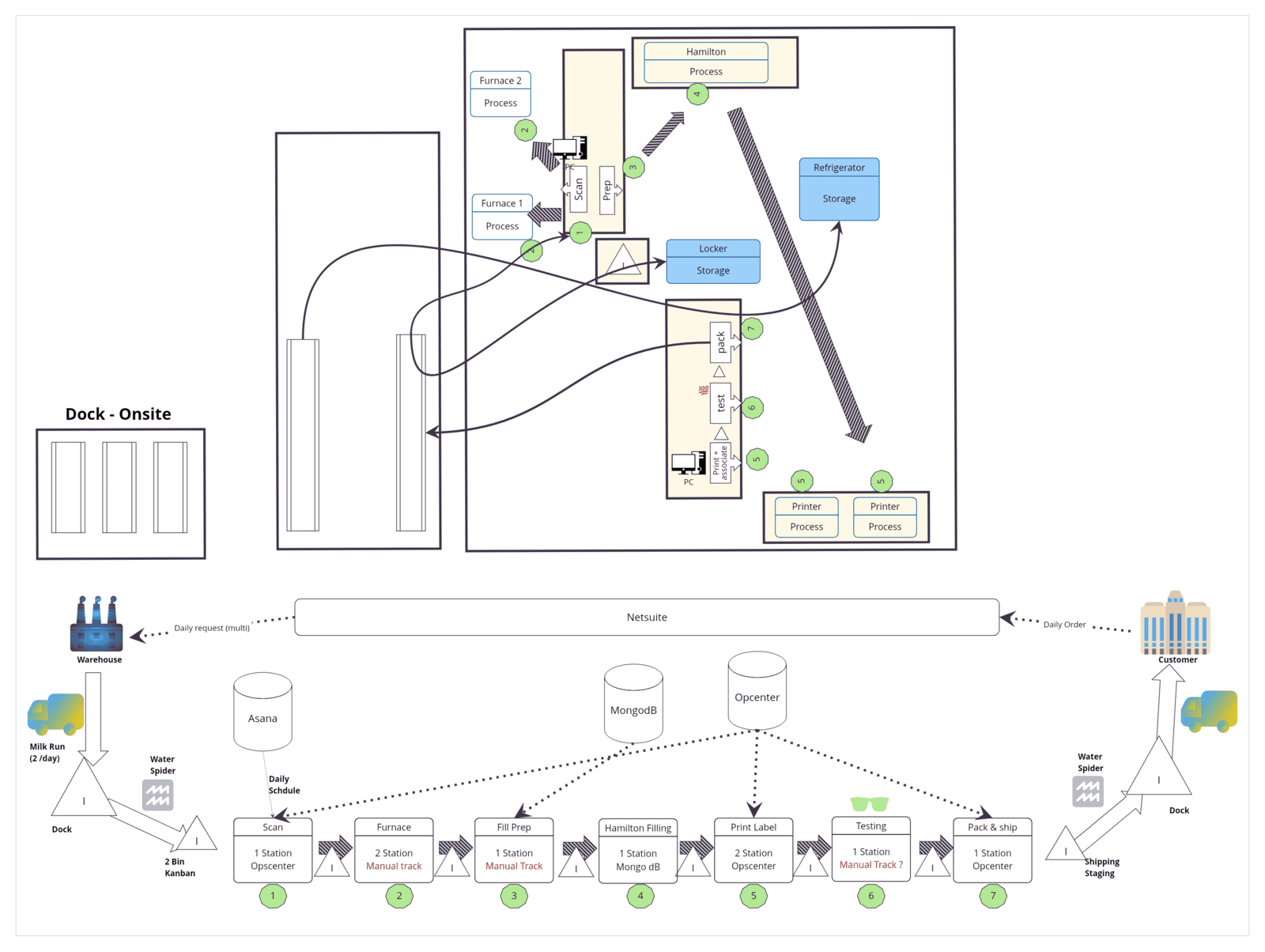
What changed in Siemens Opcenter
The future-state design focused on making Opcenter the operational thread that connected planning, execution, quality, and release. Instead of configuring screens around existing departmental habits, the team configured workflows around the cleanest flow of value.
Work-order orchestration
Material issue and transfer control
Lot and container genealogy
Electronic traveler discipline
Exception management
Performance visibility
Customer benefit
More predictable delivery, fewer last-minute release surprises, and stronger confidence that genealogy and quality records were complete before shipment.
Operations benefit
Less manual reconciliation, fewer duplicate container or lot risks, clearer WIP ownership, and smoother coordination across manufacturing, materials, quality, and engineering.
Opcenter benefit
A cleaner configuration backlog, better workflow requirements, and a system design that supported the future process instead of digitizing current-state waste.
What made the VSM successful
- Cross-functional ownership: manufacturing, supply chain, quality, engineering, and digital operations worked from one map.
- Gemba-first thinking: the team validated the actual flow instead of assuming the procedure or system record told the full story.
- No solution jumping: kaizen bursts captured issues first; the impact matrix then separated quick wins from larger design work.
- Digital workflow discipline: Opcenter requirements were tied to the future-state map, action plan, owners, and measurable benefits.
Measures to sustain the gain
The team aligned on a short list of metrics to monitor after implementation:
- Material transfer accuracy and unresolved transaction aging.
- Lot/container genealogy completeness at release.
- Queue time before QA review and disposition.
- First-pass execution through critical Opcenter workflow steps.
- Schedule adherence for the line-extension value stream.
The lesson: VSM makes digital transformation operational
When teams begin with Value Stream Mapping, Siemens Opcenter implementation becomes more than a software configuration activity. It becomes a disciplined operating-model redesign: fewer disconnected handoffs, clearer material and information flow, stronger traceability, and a workflow that can scale with new products, new manufacturing areas, and higher customer expectations.